How to Compare Hearing Support Supplements Without Falling for Weak Evidence
The best hearing-support supplement comparison is not a ranking by bottle count or ingredient quantity. A strong comparison checks the exact user goal, the evidence behind each ingredient, finished-product testing, dose transparency, safety, merchant legitimacy and whether the offer terms are current and verifiable.
Affiliate disclosure: GetGlobalOffers may earn a commission if you purchase through the Audifort offer links on this page. Research conclusions are written independently of commission.
BUY PRODUCT: See the Current Audifort Offer
Audifort is one commercial hearing-support option. Review the research guide first, then verify the live package, shipping and guarantee terms before buying.
Research guide at a glance
- Step 1: Define the outcome you are actually trying to improve
- Step 2: Separate ingredient evidence from product evidence
- Step 3: Score formula transparency and dose clarity
- Step 4: Check safety, interactions and contraindications
- Step 5: Verify seller, price, guarantee and fulfillment
- Step 6: Reject the biggest red flags
Step 1: Define the outcome you are actually trying to improve
“Hearing support” can mean very different things: maintaining general nutrition, reducing noise risk, addressing tinnitus distress, exploring age-related hearing concerns or correcting a documented deficiency. A product cannot be judged intelligently until the goal is explicit.
If the goal is treatment of sudden or persistent hearing symptoms, professional evaluation comes before supplement comparison. If the goal is general wellness, a product can be compared on nutrition, formulation, safety and value without pretending it treats disease.
Step 2: Separate ingredient evidence from product evidence
This is the most important comparison rule. Human research may support interest in nutrients such as magnesium, folate, vitamin B12, carotenoids or selected antioxidants in particular contexts. That does not establish that a branded blend containing one or more of those ingredients produces the same result.
Give the highest confidence to finished-product randomized trials that match the product, dose, population and claimed endpoint. If those do not exist, downgrade the claim and treat ingredient research as contextual support only.
Step 3: Score formula transparency and dose clarity
A long ingredient list can look impressive while making evidence harder to interpret. Prefer products that disclose exact amounts, forms and serving instructions. Proprietary blends or vague “complexes” make it difficult to compare the formula with published studies or assess whether doses are meaningful.
Also check whether the product's suggested use creates high cumulative exposure when combined with other supplements or fortified foods.
Step 4: Check safety, interactions and contraindications
Botanical extracts, minerals and amino-acid-related ingredients can interact with medicines or aggravate certain conditions. The appropriate safety review depends on the actual formula. People taking prescription drugs, managing chronic illness, pregnant or breastfeeding, or preparing for surgery should be especially cautious.
Safety is also a marketing-quality signal. A page that talks only about benefits and never acknowledges uncertainty or interactions is giving you an incomplete decision picture.
Step 5: Verify seller, price, guarantee and fulfillment
Commercial legitimacy is separate from clinical efficacy. Confirm the seller identity, secure checkout destination, package sizes, per-bottle price, shipping terms and written refund conditions. Screenshots and affiliate pages can become stale, so live offer terms should be checked at the point of purchase.
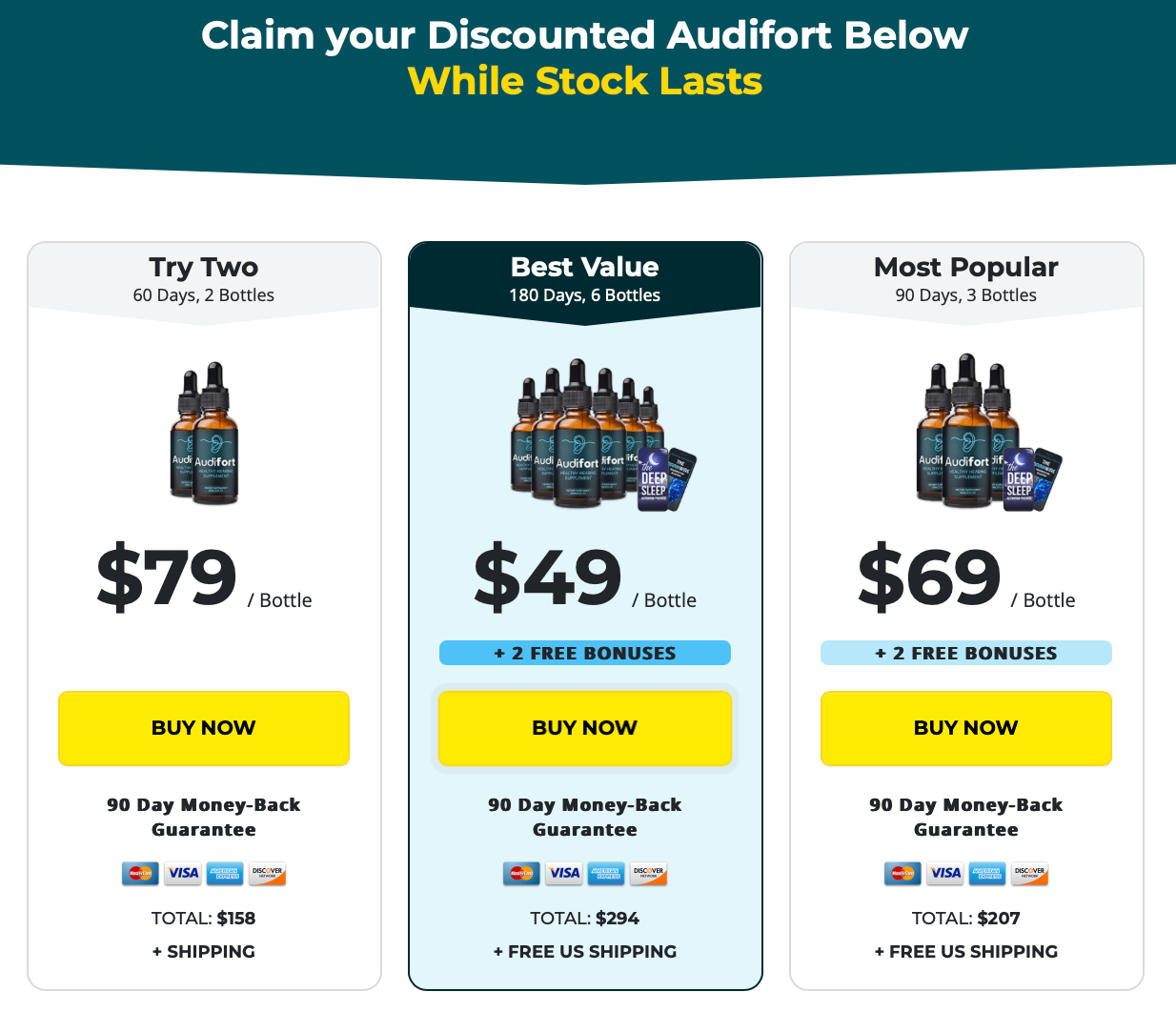
For Audifort, the current supplied merchant materials describe 2-, 3- and 6-bottle packages and a stated 90-day refund window. Those are commercial facts, not evidence that the product improves hearing.
Step 6: Reject the biggest red flags
Red flags include “FDA approved supplement” language, guaranteed restoration of hearing, tinnitus cure claims, invented clinician endorsements, fake countdown timers, undisclosed recurring billing and ratings that cannot be substantiated. Dietary supplements can be sold legally without FDA premarket approval as drugs, so an “FDA approved” badge should not be used unless it refers to something genuinely approved in the legally correct sense.
A trustworthy comparison should be willing to say when evidence is uncertain. That is not anti-product. It is what allows genuine product strengths such as transparent formula, convenient format, current pricing or a refund policy to stand on their own.
Build a simple scoring system before comparing brands
A scoring system reduces the tendency to be swayed by the most dramatic landing page. Give separate scores for formula transparency, finished-product evidence, ingredient relevance, safety disclosure, seller legitimacy, refund clarity and total cost. Keep efficacy evidence separate from commercial convenience so that a generous guarantee does not accidentally become a proxy for medical effectiveness.
For example, a product could score well on seller transparency and refund terms but poorly on finished-product clinical evidence. Another might have a simpler formula supported by relevant ingredient research but offer less favorable shipping. That comparison is more useful than declaring one product “best” without stating the criteria.
Calculate the real cost, not only the headline price
Compare total checkout cost, bottle count, servings per bottle, shipping, taxes if applicable and whether bonuses materially matter to you. A lower per-bottle price on a large bundle may reduce unit cost while increasing the amount of money committed upfront. A buyer who is uncertain about tolerance or fit may rationally prefer a smaller package even at a higher unit price.
Check the claim against the evidence sentence by sentence
Take each major claim and ask what type of evidence would be needed to support it. “Contains magnesium” requires a label. “Magnesium has been studied in hearing research” requires relevant literature. “This product improves hearing” would require evidence on the finished product and the claimed outcome. Keeping those levels separate is one of the fastest ways to identify overstatement.
Finally, remember that a good comparison should leave room for “none of these products is appropriate for this goal.” If the user's priority is sudden hearing change, one-sided symptoms or persistent bothersome tinnitus, the next step may be clinical assessment rather than another supplement shortlist.
Decision framework: what deserves the most weight?
| Question | Higher-confidence signal | Lower-confidence signal |
|---|---|---|
| Does an ingredient relate to hearing biology? | Human studies with relevant auditory outcomes | Mechanism-only or animal evidence |
| Does a branded product work? | Trials of the finished product at the marketed dose | Evidence borrowed from one ingredient |
| Is a product safe for you? | Formula-specific safety data plus clinician/pharmacist review when needed | “Natural means safe” marketing |
| Is the offer legitimate? | Identifiable seller, secure checkout, clear terms and refund policy | Unverifiable ratings, urgency or marketplace listings |
| What protects hearing from loud noise? | Lower exposure and appropriate hearing protection | Using a supplement while exposure continues |
BUY PRODUCT: Compare the Research With the Current Offer
Audifort can be evaluated as a multi-ingredient liquid supplement with a current merchant offer. The research above should guide expectations; the commercial link should not replace medical or audiological care.
View Current Audifort OfferRelated hearing-health guides and Audifort research
Hearing Support Supplements Vitamins and Hearing Health Antioxidants and Hearing Health Magnesium and Hearing Health Tinnitus Supplements How to Compare Hearing Support Supplements Without Falling for Weak Evidence
Audifort Review · Audifort Ingredients · Does Audifort Work? · Audifort Side Effects · Audifort and Tinnitus · Audifort Alternatives
BUY PRODUCT: Ready to Check Audifort Packages?
Use the official affiliate destination below and recheck the live price, shipping and refund terms before completing any order.
Check Audifort PackagesAffiliate link. Offer terms can change.
Sources and verification notes
- Protective effects of dietary nutrients on hearing loss: a systematic review and meta-analysis.
- Antioxidant vitamins and magnesium and the risk of hearing loss in the US general population.
- Protective effects of vitamins/antioxidants on occupational noise-induced hearing loss: a systematic review.
- Clinical practice guideline: tinnitus.
- CDC: Preventing Noise-Induced Hearing Loss.
- American Hearing + Audiology: The Sound of Wellness: Supplements for Hearing Health.
- Audifort merchant and affiliate-resource archives supplied with this project, used only for product identity, package, offer, guarantee and seller-route facts.
Health disclaimer: This guide is educational and is not medical advice. Dietary supplements are not substitutes for diagnosis or treatment. Seek qualified care for sudden hearing loss, persistent or one-sided tinnitus, severe dizziness, ear pain, neurologic symptoms or other concerning changes.